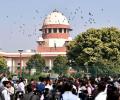
The Supreme Court Wednesday said the new system of mentioning cases for urgent hearing before apex court officials instead of its benches directly has been put in place to ensure that senior lawyers are not given "special priority" over their junior colleagues.
Section 6A, which was incorporated in the Citizenship Act 1955 following the signing of the 1985 Assam Accord, was upheld by the Supreme Court.
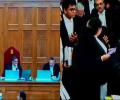
Who can recommend the revocation of Article 370 in Jammu and Kashmir when no constituent assembly exists there? The Supreme Court on Wednesday put this question to the petitioners who have challenged the abrogation of the constitutional provision that bestowed special status on the erstwhile state.

On February 1, grappling with the intractable issue of the AMU's minority status, the top court said the 1981 amendment to the AMU Act, which effectively accorded it a minority status, only did a "half-hearted job" and did not restore the institution the position it had prior to 1951.
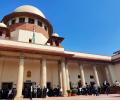
A five-judge bench headed by Chief Justice DY Chandrachud considered the pleas in chambers and dismissed applications for listing of the review petition in open Court.

Kejriwal, who was arrested on March 21 by the Enforcement Directorate (ED) in the same case and later by the CBI which was probing corruption charges, stepped out after spending 155 days in Tihar jail. The AAP supremo, who was earlier granted three-week interim bail in the ED case, was given a resounding welcome by his party leaders and supporters who were drenched in heavy rain. Addressing party workers from the top of an SUV, Kejriwal, sporting a half-sleeve blue shirt, raised 'Inquilab Zindabad' and 'Vande Mataram' slogans.

The Supreme Court on Wednesday expunged the observations made by a single judge bench of the Punjab and Haryana high court against the apex court in a contempt case, saying they were "scandalous" and "unwarranted".
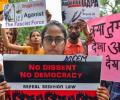
The Supreme Court on Thursday said it would hear arguments on May 10 on the legal question whether the pleas challenging the colonial era penal law on sedition be referred to a larger bench, and granted time to the Centre to file its response.

The bench posed questions to senior advocate Gopal Sankaranarayanan, appearing for one of the petitioners Soayib Qureshi, who has challenged the Centre's August 5, 2019 decision to abrogate the provision.

A five-judge bench headed by Chief Justice D Y Chandrachud noted that Karnataka high court judge Justice Vedavyasachar Srishananda, who had made those observations, had on September 21 tendered an apology for his comments in the open court there.

It is for the first time in the history of the apex court that nine judges took oath of office at one go.

A bench comprising Chief Justice N V Ramana and Justices Surya Kant and Hima Kohli has listed as many as 12 PILs, including the ones filed by Editors Guild of India and veteran journalists N Ram and Sashi Kumar, for hearing on February 23.
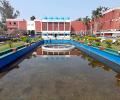
Merely because an educational institution is regulated by a statute does not take away from it the character of a minority institution, the Supreme Court observed on Tuesday as it commenced hearing the vexed question of minority status of Aligarh Muslim University (AMU).

Article 370 of the Constitution, which bestowed special status on the erstwhile state of Jammu and Kashmir, was a 'temporary provision' and any interpretation of the provision cannot postulate that integration of J-K with India was temporary, the Supreme Court ruled on Monday.

The Supreme Court has agreed to hear on Wednesday a plea related to the economically weaker section quota in NEET-PG admissions, after the Centre sought urgent hearing in the matter.
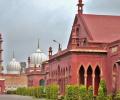
There is nothing "fundamentally inconsistent" with a minority institution being an institution of national importance (INI), the Supreme Court said on Wednesday while hearing arguments on the vexed issue of minority status to Aligarh Muslim University (AMU).

The Supreme Court on Monday asked National Conference leader Mohammed Akbar Lone to file an affidavit swearing allegiance to the Constitution of India and accepting the country's sovereignty, after the 'Pakistan zindabad' slogan that he allegedly raised in the Jammu and Kashmir assembly in 2018 kicked up a massive row.

In an unprecedented decision, the Supreme Court Collegium has recommended the names of three women judges for appointment in the apex court which, if cleared, would give the country its first woman Chief Justice of India (CJI) in the form of Justice B V Nagarathna on February 10, 2027.
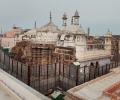
The Supreme Court on Monday agreed to hear on April 14 a plea by the Anjuman Intezamia Masjid committee seeking permission for wazu (ritual ablution) at the Gyanvapi mosque complex in Varanasi during the month of Ramzan.

The apex court has also sought details of the Special Investigation Team (SIT) and the judicial enquiry commission, reportedly set up by the state government.

How does it matter for people whether the Aligarh Muslim University is a minority institution or not when it has continued to be an institute of national importance without the minority tag, the Supreme Court said on Thursday as it underlined that the intent of Article 30 of the Constitution is not to "ghettoise the minority".
An institution of national importance must reflect the "national structure", the Centre told the Supreme Court on Tuesday while pointing out that around 70 to 80 per cent students studying at Aligarh Muslim University (AMU) are Muslims even without reservation.

In an emphatic victory for the Modi government, the Supreme Court on Monday unanimously upheld its decision to abrogate Article 370 of the Constitution that bestowed special status upon the erstwhile state of Jammu and Kashmir, ordered restoration of statehood "at the earliest" and set a September 30, 2024, deadline for holding the assembly elections.
National Conference leader Mohammed Akbar Lone on Tuesday filed an affidavit in the Supreme Court reiterating his oath as Lok Sabha MP, saying he will preserve and uphold the Constitution and protect the country's territorial integrity, an undertaking that irked the Centre which claimed it added "insult to injury to the nation".

As the Supreme Court on Wednesday put on hold the application of sedition law, Union Law Minister Kiren Rijiju invoked "Lakshman Rekha" guiding different institutions, including the Executive and the Judiciary, and said no one should cross their "boundary".

The five-judge constitution bench headed by Chief Justice DY Chandrachud, which heard their contentions at length, told them they will have to justify the procedure adopted for abrogation as the court cannot postulate a situation "where the ends justify the means".

The Supreme Court on Tuesday termed as "unacceptable" the submission that Article 370 of the Constitution ceased to operate once the term of the constituent assembly of Jammu and Kashmir ended in 1957 after drafting the state's constitution.

Grappling with the intractable issue of Aligarh Muslim University's minority status, the Supreme Court said on Thursday the 1981 amendment to the AMU Act, which effectively accorded it a minority status, only did a "half-hearted job" and not restore to the institution the position it had prior to 1951.

The judges on the bench are CJI S A Bobde, Justices R Banumathi, Ashok Bhushan, L Nageswara Rao, M M Shantanagoudar, S A Nazeer, R Subhash Reddy, B R Gavai and Surya Kant.

The Supreme Court is scheduled to hear on Wednesday a petition seeking a direction to ensure investigation and action against those who allegedly made hate speeches during two events held recently in Haridwar and the national capital.
"There is no freedom to the judges to even file a complaint," a bench comprising Chief Justice N V Ramana and Justice Surya Kant said, adding that police or the CBI is not helping the judiciary if such complaints are filed.

The Supreme Court of India on Wednesday appointed Justice Rakesh Kumar Jain, a former judge of the Punjab and Haryana high court, to supervise the Uttar Pradesh SIT's probe on day-to-day basis into the Lakhimpur Kheri violence in which eight people including four farmers were killed on October 3.
The mere fact that some part of administration of an educational institution is also looked after by non-minority officials does not "dilute" its minority character, the Supreme Court observed on Wednesday while hearing the hugely disputed minority status of Aligarh Muslim University (AMU).
The central government's response was conveyed to the court by Solicitor General Tushar Mehta, after a five-judge constitution bench headed by Chief Justice DY Chandrachud, hearing the pleas challenging the abrogation of Article 370, asked it to set a specific time frame for restoration of electoral democracy in the erstwhile state.

"We are confined to health issue. It is in the interest of the state also that the accused gets better treatment," the bench comprising Justices Surya Kant and A S Bopanna observed.
Is there no mechanism to abrogate Article 370 even when the people of Jammu and Kashmir want it, the Supreme Court asked on Thursday and wondered if the now repealed provision can't be touched, will it not amount to creating a "new category" beyond the basic structure of the Constitution.
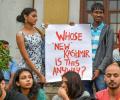
The Supreme Court said on Thursday the surrender of Jammu and Kashmir's sovereignty to India was "absolutely complete" with the accession of the former princely state in October 1947, and it was "really difficult" to say that Article 370 of the Constitution, which accorded special status to the erstwhile state, was permanent in nature.

The Supreme Court said on Thursday it will set up a fresh five-judge Constitution bench to hear the pleas challenging the constitutional validity of polygamy and 'nikah halala' among Muslims.
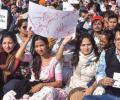
The Supreme Court on Thursday directed the Centre and the Assam government to provide extensive data, including those on the number of Bangladeshi immigrants granted Indian citizenship in Assam between January 1, 1966 and March 25, 1971, while taking note of pleas that illegal immigration has impacted demography and cultural fabric of the border state.

Elections in Jammu and Kashmir can be held "anytime from now" as the work on updation of voters list is almost over, the Centre told the Supreme Court on Thursday but remained non-committal about setting a time-frame for restoration of statehood to the Union territory (UT).
